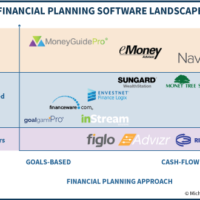
As a financial advisor, having the right financial planning software is essential. In today’s world, where making good financial decisions requires complex calculations and projections, it is impossible to do it all without the assistance of technology. Financial planning software fills this void by calculating projected outcomes, allowing you to evaluate the consequences of different financial trade-offs or decisions. However, choosing the best financial planning software can be challenging, as not every advisor serves the same types of clients or has the same approach to analyzing financial planning situations. In this guide, we will explore the factors you should consider when choosing financial planning software and review some of the top options in the market.
Factors To Consider When Choosing Financial Planning Software
Goals Based vs Cash Flow Based Financial Planning Software
One of the key differentiators among financial planning software is whether it is goals-based or cash flow-based. Goals-based software focuses on capturing dollars allocated towards specific goals and projects whether those goals will be achieved. On the other hand, cash flow-based software aims to account for every dollar in the household, including inflows and outflows, to provide a comprehensive view of the household’s finances. Understanding the distinction between these two approaches is essential in choosing the right software for your needs.
Financial Planning Software Models: Straight Line vs Monte Carlo And What-If Scenarios
Another important factor to consider is how the software models projections. Some software projects on a linear straight-line basis, assuming a flat annual return. Other software uses Monte Carlo analysis to simulate a wider range of returns. Additionally, consider whether the software allows you to simulate different what-if scenarios and adjust inputs to show how the plan outcomes may change. Understanding how the software models projections and analyzes scenarios is crucial for effective financial planning.
Financial Planning Software Output – Interactive Tools Vs Printed Reports
In the past, financial planning software primarily focused on generating detailed printed reports. While most software still provides this capability, today’s software is increasingly shifting towards interactive tools that can be used collaboratively with clients. Consider whether the software allows for interactive planning sessions with clients, enabling you to change inputs on the fly and see the impact on outcomes. Having software with a user-friendly interface that facilitates collaboration with clients can greatly enhance the planning experience.
Ease Of Input And Flexibility Of Financial Planning Software Assumptions
The ease and flexibility of inputting data into the software are also crucial considerations. Consider how natural and intuitive the software’s data input process is and whether the software allows for customization of assumptions. Some software may force you to use pre-set inputs determined by the software makers, while others allow you to specify your own inputs. The input process should be easy to learn and use, as it can greatly impact your efficiency as a financial advisor.
Modular Financial Planning Tools
While the focus of most financial planning software is on wealth accumulation and retirement planning, many clients have needs in other areas of financial planning. Consider whether the software includes modules for evaluating insurance coverage, college savings, social security timing, retirement drawdowns, stock options, and tax planning. Having a comprehensive suite of tools can help you address the diverse needs of your clients.
Client PFM Portals
As financial planning software transitions into a holistic financial planning experience, client personal financial management (PFM) portals become increasingly important. These portals provide clients with a dashboard to view their financial plans and accounts, enhancing their engagement and involvement in the planning process. Consider whether the software you choose offers a client PFM portal and whether it provides robust tools for tracking cash flow and managing finances.
Automatic Client Data Updates Through Account Aggregation And Other Integrations
To streamline the financial planning process, consider whether the software uses account aggregation to automatically update client account balances. Account aggregation eliminates the need for manual data input and ensures the plan is continuously updated. Additionally, look for software that integrates with other tools and platforms you use, such as CRM or portfolio accounting software, to enhance efficiency and workflow.
Other Add-On Tools And Services From Financial Planning Software Companies
Some financial planning software companies offer add-on tools and services beyond the core software. These tools may include content marketing solutions, client portals, prospecting tools, or marketing support. Consider whether these add-ons are relevant to your needs and whether they are deeply integrated into the software. Having seamless integration between different tools can improve your overall workflow and client experience.
A Review Of The Financial Planning Software Landscape
Given the factors mentioned above, it is essential to understand the options available in the financial planning software market. Below is a summary of some of the top financial planning software solutions and their key features:
-
MoneyGuidePro: A goals-based financial planning software known for its user-friendly interface and strong focus on client experience. Pricing starts at $1,295/year.
-
eMoney Advisor: Known for its leading client PFM portal and comprehensive financial planning software. Pricing starts at $2,592/year.
-
NaviPlan: A cash-flow based financial planning software with robust features for detailed cash flow analysis. Pricing starts at $2,195/year.
-
FinanceLogix: Offers comprehensive planning tools and a robust advisor dashboard for relationship management. Pricing starts at $1,200/year.
-
MoneyTree: Known for its accuracy and detailed audit trail, with different tiers of software to suit different planning needs. Pricing starts at $371/year.
-
GoalGami Pro: Provides a simplified planning process with streamlined data entry and a focus on the household balance sheet approach. Pricing starts at $495/year.
-
InStream: A comprehensive financial planning software with a strong focus on tracking and monitoring client plans over time. Pricing starts at $115/month.
-
WealthTec: A highly analytical financial planning software for complex planning needs, particularly for high net worth clients. Pricing starts at $1,495/year.
-
FinanceWare: Offers in-depth Monte Carlo analysis tools for simulating wealth accumulation and spenddown strategies. Pricing starts at $90/year per client.
-
SunGard WealthStation: A comprehensive financial planning software within a larger technology suite for enterprises. Pricing starts at $475/year for WealthStation CompAct.
-
Figlo: A goals-based financial planning software with a visual timeline of the client’s financial lifeline. Pricing starts at $1,495/year.
-
Advizr: A modern and user-friendly financial planning software with collaborative features and a focus on younger clients. Pricing starts at $75/month.
-
RightCapital: A new financial planning software with in-depth tax planning tools and a modern user interface. Pricing starts at $50/month.
Consider these options and their features, keeping in mind the factors that are most relevant to your specific situation and client needs. Obtaining a quote directly from the software company will provide you with the most accurate pricing information based on your requirements.
In conclusion, choosing the best financial planning software is a critical decision for any financial advisor. By considering factors such as goals vs cash flow orientation, modeling capabilities, output options, ease of input, and integration with other tools, you can find the software that best aligns with your needs and enhances your ability to serve your clients.