Software development models are various processes or methods chosen for project development based on the objectives and goals. These models specify the steps of the process and the order in which they are executed. The choice of model greatly impacts the testing process, including what aspects of the software are tested, when testing occurs, and how testing activities are connected.
What is Software Modeling?
Software modeling is the process of creating abstract representations of a software system. These models serve as blueprints that guide developers, designers, and stakeholders through the system’s structure, behavior, and functionality. By using diagrams and modeling languages, software modeling helps in visualizing and understanding the complex aspects of the software, making it easier to plan, develop, and manage the system.
Top 8 Software Development Models
Choosing the right model is crucial for the development of a software product or application. Different companies choose the development model based on their specific needs. Let’s explore the top 8 software development models in brief:
1. Waterfall Model
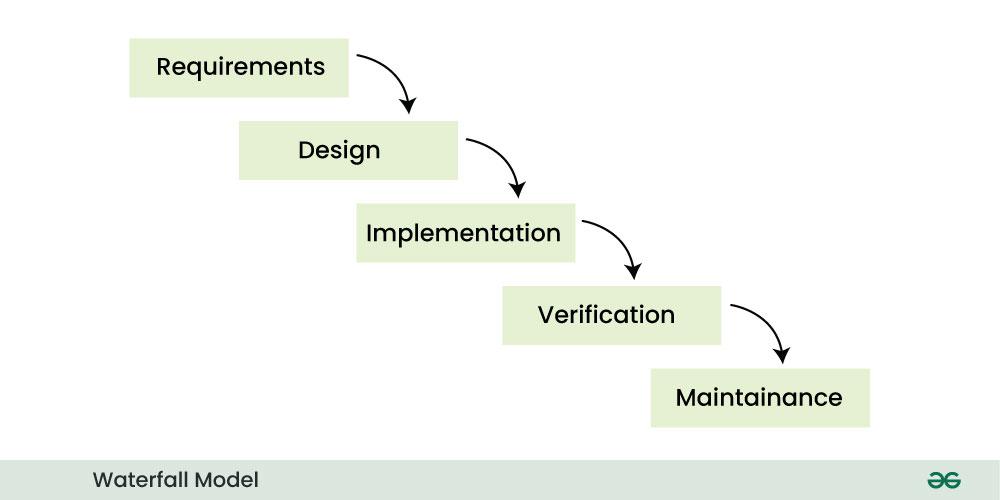
The waterfall model is a linear and sequential model where each development phase must be completed before moving on to the next. It is like a waterfall, where progress flows in one direction. The phases of the waterfall model include:
- Requirement phase: Collect and document the system requirements.
- Design phase: Prepare the blueprint of the software system.
- Implementation phase: Install and implement hardware, software, and application programs.
- Verification phase: Verify the software and conduct various types of testing.
- Maintenance phase: Solve problems and maintain the finished software.
Advantages:
- Simple and easy to understand
- Provides a structured way of development
- Ensures a well-explained approach for each phase
Disadvantages:
- Requires complete and accurate requirements upfront
- Limited flexibility for changes and updates
- Testing comes late in the process
2. V-Model
The V-Model is a disciplined model that associates testing phases with each development phase. It follows a V-shaped approach, where testing activities are aligned with development activities. The V-Model phases include:
- Requirements analysis
- System design
- Architectural design
- Module design
- Coding phase
- Unit testing
- Integration testing
- System testing
- Acceptance testing
Advantages:
- Planning, testing, and designing can be done before coding
- Defects are detected in the early stages
- Suitable for small and medium-scale projects
Disadvantages:
- Not suitable for complex projects
- Requires clear and accurate requirements
- Limited flexibility for changes
3. Incremental Model
The Incremental Model divides the software development process into increments or modules. Each increment follows the same phases and is developed based on specific requirements. Important functionalities are developed in the initial iterations, and new modules are added until the complete system is developed.
Phases: Communication, Planning, Modeling, Construction, Deployment
Advantages:
- Important modules/functions are developed first
- Working software is prepared quickly
- Flexible and less expensive for changing requirements
Disadvantages:
- Management is a continuous activity
- Requires clear project requirements
- Increases the total cost
4. RAD Model
The RAD (Rapid Application Development) Model is suitable for small projects. It divides large projects into small modules and completes them individually. The RAD model focuses on reusing code, components, tools, and processes in project development.
Phases: Business modeling, Data modeling, Process modeling, Application generation, Testing and turnover
Advantages:
- Reduces development time
- Allows code reusability
- Cost-effective and suitable for small projects
Disadvantages:
- Requires highly skilled developers and designers
- Difficult to manage
- Not suitable for ongoing projects
5. Iterative Model
The Iterative Model develops software in repeated cycles or iterations. Each iteration involves planning, design, implementation, testing, review, and maintenance. The model allows for modifications and changes based on feedback received from users and customers.
Phases: Requirement gathering & analysis, Design, Implementation, Testing, Deployment, Review, Maintenance
Advantages:
- Quick identification of bugs and errors
- Working software is prepared with specifications
- Reliable feedback and adaptability to changing needs
Disadvantages:
- Not suitable for small projects
- Requires more resources due to iterations
- Increased cost and time for changing requirements
6. Spiral Model
The Spiral Model is a combination of iterative and waterfall models. It divides the software development process into phases or loops, focusing on risk identification and resolution. Each loop consists of determining objectives, identifying and resolving risks, development and testing, and reviewing for the next phase.
Advantages:
- Allows making changes in the middle of development
- Suitable for large and complex projects
- Risk analysis in each phase
Disadvantages:
- Complex and difficult to manage
- Not suitable for small projects
- High cost and documentation requirements
7. Prototype Model
The Prototype Model involves creating prototypes of software applications before developing the final product. It is used when requirements are not well-defined. The model enables feedback and changes based on the prototype’s evaluation.
Phases: Requirement gathering, Build the initial prototype, Review the prototype, Revise and improve the prototype
Advantages:
- Suitable for easy prototypes and human-machine interaction
- Helpful when requirements are not well-defined
- Can be used in combination with other models
Disadvantages:
- Multiple iterations can consume time and money
- Compromises in the first version of the prototype
- Requires experienced programmers and designers
8. Agile Model
The Agile Model combines iterative and incremental approaches, focusing on adaptability and customer satisfaction. It divides the software product into small incremental parts and develops them in short iterations called sprints. Agile methodologies like Scrum, Crystal Methods, and Extreme Programming are popular within this model.
Advantages:
- Error-free code through collaboration
- Quick completion of software projects
- Flexibility and adaptability to changing requirements
Disadvantages:
- Complex dependencies are challenging to handle
- Requires experienced programmers
- Difficult to estimate effort and time for software development
Why companies are shifting toward Agile Software Development models?
Agile methodologies have gained popularity due to their flexibility and customer-centric approach. In the past, the waterfall model led to challenges when customers requested changes during software development. Agile models allow for changes in the middle of development, resulting in faster project completion.
Agile approaches focus on regular feedback from customers and stakeholders, enabling quicker adaptation to changing requirements. By adopting Agile methodologies like Scrum, companies can accelerate time-to-market for new features and products, increase customer satisfaction, and achieve successful project outcomes.
In conclusion, choosing the right software development model is essential for project success. Each model offers advantages and is suitable for different projects. Agile methodologies provide flexibility, adaptability, and customer-centricity, making them increasingly popular in the industry.